

Spravato vs. IM Ketamine: What’s the Difference?
A practical guide to two related—but distinct—depression treatments.
Spravato and intramuscular ketamine are often discussed together because both are related to ketamine and may be considered when standard depression treatments have not provided enough relief. That does not make them interchangeable. They differ in their chemical formulation, route of administration, FDA status, treatment rules, scheduling, insurance pathways, and the amount of published evidence behind each specific approach.
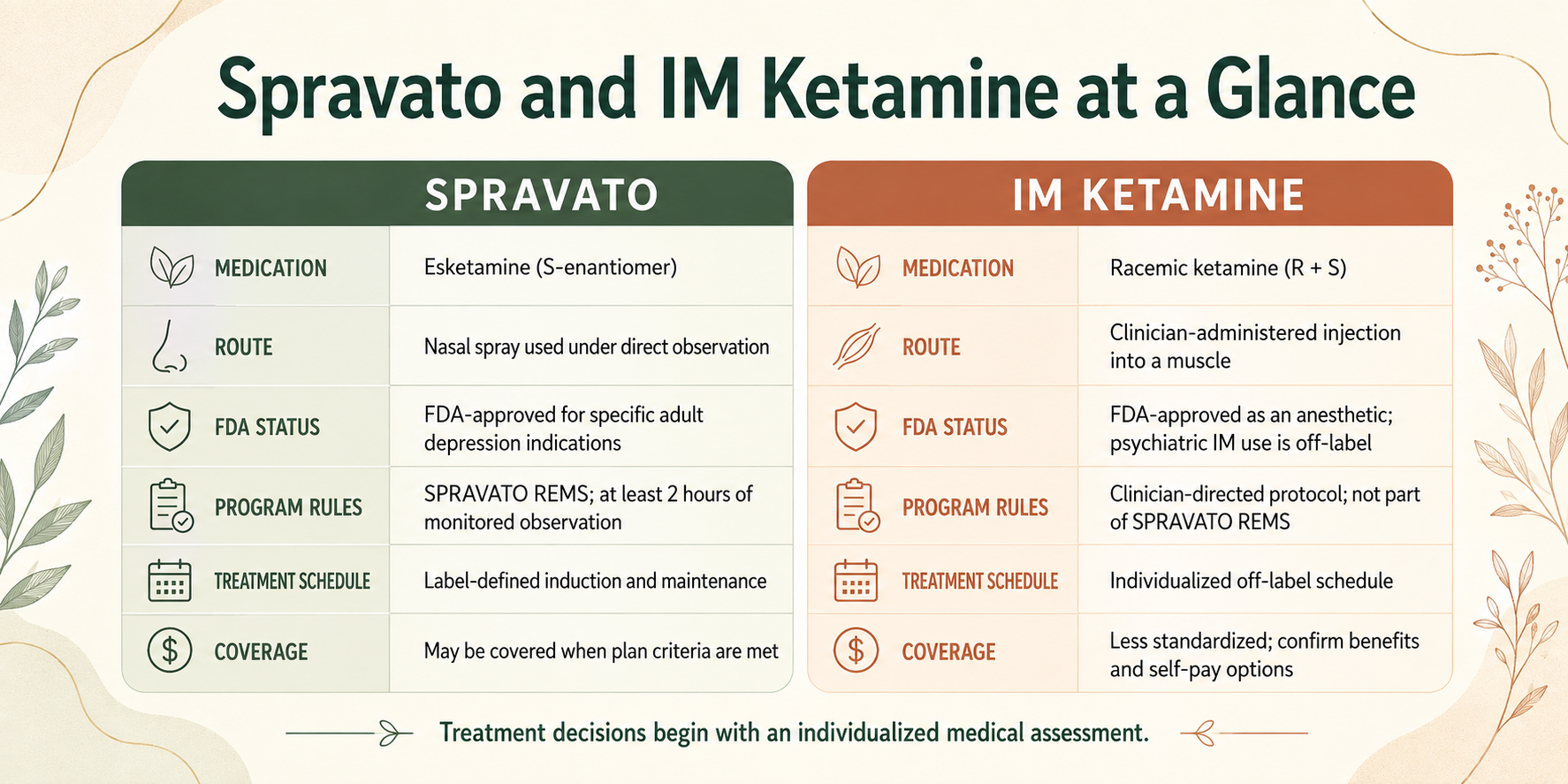
The simplest answer is this: Spravato is a brand-name esketamine nasal spray with FDA-approved psychiatric indications and a required safety program. IM ketamine uses an injection of racemic ketamine; using it for depression or another psychiatric condition is off-label. Both require careful screening and monitored treatment in an appropriate clinical setting.
At Altium Health, ketamine treatment options begin with a medical and psychiatric assessment. The goal is not to choose the treatment with the strongest marketing claim. It is to identify the option whose evidence, risks, logistics, and expected benefits fit the individual patient.
Important: Neither treatment is an emergency service or a guaranteed cure. If you are in immediate danger, may act on thoughts of suicide, or cannot remain safe, call 911 or go to the nearest emergency department. You can also call or text 988 for free, confidential crisis support.
What is Spravato?
Spravato is the brand name for esketamine, the S-enantiomer of ketamine. An enantiomer is one of two mirror-image forms of a molecule. Spravato contains the S form rather than the mixture found in racemic ketamine.
The FDA currently approves Spravato for treatment-resistant depression in adults, either by itself or with an oral antidepressant. It is also approved, together with an oral antidepressant, for depressive symptoms in adults with major depressive disorder who have acute suicidal ideation or behavior. The label specifically states that Spravato has not been shown to prevent suicide or reduce suicidal thoughts or behavior, and it does not replace hospitalization when hospitalization is clinically necessary.
Spravato is a nasal spray, but it is not taken home like an ordinary prescription. The patient uses the device in a certified healthcare setting under direct observation. The clinic monitors blood pressure, respiratory status, alertness, and other effects for at least two hours and determines when the patient is clinically stable to leave.
What is IM ketamine?
IM means intramuscular. A clinician administers ketamine by injection into a muscle, where it is absorbed into the bloodstream. The medication is racemic ketamine, meaning it contains both the R and S forms of the molecule.
Ketamine injection has long been FDA approved as an anesthetic. Its use for depression, PTSD, anxiety, or other psychiatric conditions is off-label. Off-label prescribing is legal and common across medicine when a qualified clinician determines that the available evidence and the patient's circumstances support it. The distinction still matters: an off-label psychiatric use has not gone through the same FDA approval process for that indication, route, and treatment schedule as Spravato.
Research on racemic ketamine for depression includes randomized trials, observational studies, and clinical experience. Much of the larger research base involves intravenous ketamine, while the published evidence specific to intramuscular administration is smaller and protocols vary among clinics. That makes transparent consent, careful monitoring, and individualized outcome tracking especially important.
The medications are related, but they are not identical
Spravato contains esketamine alone. IM ketamine generally contains the racemic mixture of arketamine and esketamine. Both interact with the glutamate system, including NMDA receptors, in ways that differ from conventional antidepressants. Researchers continue to study which downstream changes are most important for antidepressant effects.
It is tempting to assume that one formulation must be stronger, faster, or more complete because of its chemistry or route. Those conclusions are not reliable without considering dose, absorption, diagnosis, study design, previous treatments, and the individual patient. A comparison between products should not be reduced to a claim that one is simply 'real ketamine' or that FDA approval automatically makes one best for every person.
The biggest difference is FDA status and standardization
Spravato follows an FDA label and REMS requirements
Spravato's prescribing information defines eligible indications, administration, an induction and maintenance framework, warnings, contraindications, and post-dose observation. Because of risks that include sedation, dissociation, respiratory depression, abuse, and misuse, the medication is distributed through the SPRAVATO Risk Evaluation and Mitigation Strategy, or REMS. Healthcare settings and pharmacies must be certified, and outpatients must be enrolled.
IM ketamine uses an individualized off-label protocol
There is no FDA-approved psychiatric IM ketamine schedule. The prescriber develops a protocol based on the patient's diagnosis, medical history, previous response, tolerability, and the clinic's clinical standards. That flexibility can be useful, but it also means patients should ask how the protocol was developed, what outcomes are measured, how side effects are managed, and when the team changes or stops treatment.
What does a treatment visit feel like?
Both treatments can temporarily change perception, attention, balance, and the sense of connection to one's body or surroundings. Some people describe floating, distance, vivid thoughts, or altered time. Others feel dizziness, nausea, sleepiness, anxiety, or emotional discomfort. The experience varies from person to person and from session to session.
During Spravato treatment, the patient uses the nasal-spray devices under direct observation and remains at the certified site for at least two hours of monitoring. The FDA label instructs patients not to drive or operate machinery until the next day after a restful sleep, so transportation home must be arranged.
During IM ketamine treatment, a clinician administers the injection and monitors the patient's response according to the clinic's protocol. The onset, intensity, and recovery period may differ from Spravato because the medication and route are different. Patients should receive clear instructions about food and liquids, medications, transportation, driving, work, and supervision after the visit. Those instructions should come from the treating team, not from another clinic's website or a social-media account.
How do the treatment schedules differ?
For treatment-resistant depression, Spravato uses a structured schedule that begins with more frequent treatment and moves toward weekly or every-other-week maintenance when continued treatment is appropriate. The prescriber evaluates benefit and tolerability and individualizes maintenance to the least frequent schedule that maintains response or remission.
IM ketamine does not have one nationally approved psychiatric schedule. Some programs use an initial series followed by maintenance visits; others adjust frequency based on symptoms, standardized outcome measures, side effects, and the broader treatment plan. A fixed number of sessions should not be promised as universally necessary or sufficient.
Does one work better or faster?
There is no honest universal answer. Spravato has an FDA-reviewed evidence package for its labeled uses and a standardized treatment program. Racemic ketamine also has a substantial depression literature, but the amount of evidence varies by route, and IM-specific research is less extensive than the literature for intravenous ketamine or intranasal esketamine.
Head-to-head and real-world studies can inform the conversation, but they do not prove that every patient will respond the same way. Differences in diagnosis, severity, previous medication trials, dosing, visit frequency, outcome measures, and follow-up make simple comparisons difficult. Some patients respond to one option and not the other; some do not respond adequately to either.
A responsible clinic sets realistic expectations, measures symptoms over time, asks about function and quality of life, monitors adverse effects, and changes course when the balance of benefit and burden is not favorable.
How do cost and insurance differ?
Spravato may be covered by insurance when the patient meets the plan's medical-necessity criteria, prior treatment requirements, and authorization rules. Coverage can involve separate medication and office-monitoring benefits, copays, coinsurance, deductibles, specialty-pharmacy requirements, or manufacturer assistance. FDA approval does not guarantee coverage.
Because psychiatric IM ketamine is off-label, insurance coverage is less standardized and some clinics provide it primarily as a self-pay service. The relevant comparison is the full expected cost of the treatment plan—not only the price of one visit—including evaluation, medication, monitoring, maintenance, transportation, and missed work when applicable.
Before beginning, ask the clinic to verify your benefits and explain which charges are expected to be billed to insurance and which are self-pay. Verification is not a guarantee that a claim will be paid.
How does a clinician decide which option may fit?
The decision begins with diagnosis and treatment history. Spravato's FDA-approved uses are specific. IM ketamine may be considered off-label in a wider range of situations, but broader possible use does not mean broader proven benefit. The prescriber should identify the target symptoms, why this treatment is being considered, and how success will be measured.
The assessment also reviews blood pressure and cardiovascular risk, neurological and medical history, pregnancy or pregnancy planning, current medications, substance-use history, psychosis or mania risk, previous dissociation or anesthesia experiences, transportation, ability to attend repeated visits, cost, insurance requirements, and patient preference. Spravato has specific contraindications and warnings in its label; IM ketamine requires its own route-appropriate medical review.
Finally, treatment should fit into a larger plan. Rapid symptom improvement can create an important opening, but it does not automatically address relationships, trauma, sleep, habits, work stress, or the thinking and behavioral patterns that maintain depression. Medication management, psychotherapy, lifestyle support, and other treatments may still be essential.
Questions to ask before choosing a clinic
Experience: Which formulation and route are you recommending, and why does it fit my diagnosis and history?
Approval status: Is this an FDA-approved use or an off-label use, and what does that mean for consent and evidence?
Monitoring: Which vital signs and symptoms are monitored, for how long, and who is present during recovery?
Outcomes: Which standardized symptom measures will you use, and when will we decide whether treatment is helping?
Safety: What side effects or medical changes should delay treatment or require urgent care?
Logistics: What are the transportation, driving, food, liquid, medication, and time-off requirements?
Cost: What will insurance be asked to cover, what could remain my responsibility, and what happens if authorization is denied?
Continued care: How will ketamine or Spravato be coordinated with my prescriber, therapist, and longer-term treatment plan?
Frequently asked questions
Is Spravato just ketamine nasal spray?
Spravato is a specific FDA-approved brand of esketamine nasal spray. It contains the S-enantiomer of ketamine and is used under a regulated REMS program. It should not be used as a generic name for compounded intranasal racemic ketamine or other nasal ketamine products.
Is IM ketamine FDA approved for depression?
No. Ketamine injection is FDA approved as an anesthetic. When a clinician administers IM ketamine for depression or another psychiatric condition, that is an off-label use. Off-label does not automatically mean inappropriate, but patients should understand the evidence, alternatives, risks, and monitoring plan.
Does Spravato still require an oral antidepressant?
For adult treatment-resistant depression, the January 2025 FDA label allows Spravato as monotherapy or together with an oral antidepressant. For depressive symptoms in adults with major depressive disorder and acute suicidal ideation or behavior, the approved use is in conjunction with an oral antidepressant. The prescriber determines the appropriate medication plan.
Can I take Spravato or IM ketamine at home?
Spravato is administered only in a certified healthcare setting under direct observation and cannot be dispensed directly to the patient for home use. This article addresses clinician-administered IM ketamine in a monitored setting, not at-home ketamine services.
Can I drive after treatment?
The Spravato label instructs patients not to drive or operate machinery until the next day after a restful sleep. IM ketamine restrictions depend on the treatment protocol, response, and medical guidance, but patients should expect to arrange transportation and follow the clinic's written instructions.
Can I switch from one treatment to the other?
A change may be considered when response, side effects, access, insurance, scheduling, or patient preference changes. Switching is not simply a product substitution. The clinician must review timing, medications, medical risk, previous response, and the goals of treatment before recommending a new plan.
What if neither option is right for me?
Treatment-resistant depression still has other evidence-based options. Depending on the person, these may include medication changes or augmentation, psychotherapy, transcranial magnetic stimulation, electroconvulsive therapy, a higher level of care, or coordinated treatment for another condition affecting mood. A comprehensive assessment should keep the full range of appropriate options open.
The right comparison is personal, not promotional
Spravato offers FDA-approved psychiatric indications, a standardized label, and a required REMS framework. IM ketamine offers a clinician-directed route using racemic ketamine, with flexibility but less standardization and an off-label psychiatric status. Those differences matter, but they do not make the decision automatically.
Altium Health provides clinician-guided ketamine treatment in West Jordan for appropriate adults. Our team can review what you have tried, clarify the differences among available options, discuss insurance and logistics, and help you determine whether ketamine treatment—or another approach—fits your needs.
Schedule a consultation or explore Altium Health's Ketamine Treatments page. Call 801-613-9843 or text 385-342-3490.
Crisis support: Altium Health is not an emergency service. If you are in immediate danger, cannot remain safe, or may act on thoughts of suicide, call 911 or go to the nearest emergency department. You can also call or text 988 for free, confidential crisis support 24 hours a day.
Medical disclaimer: This article is for general educational purposes and is not a diagnosis, prescription, individualized treatment recommendation, or substitute for medical advice. FDA labeling, clinic protocols, insurance coverage, and individual risks can change. Treatment decisions should be made with qualified professionals who can evaluate the patient directly.
